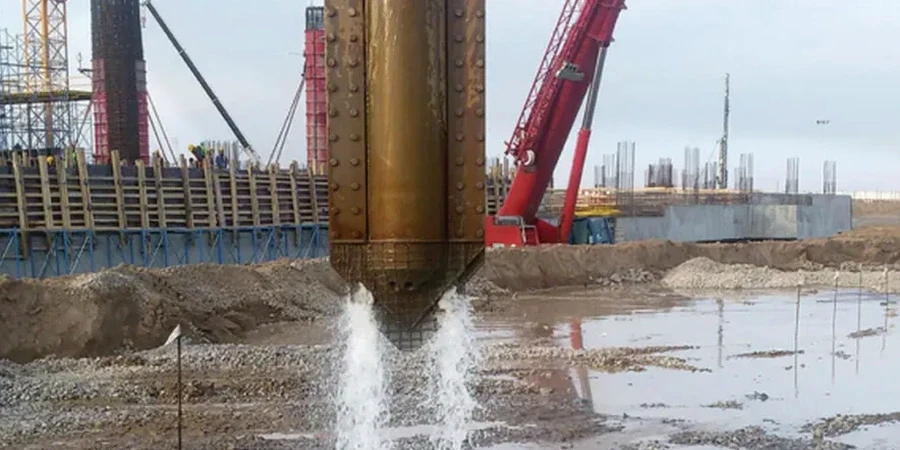
A six-storey mixed-use development on a former steelworks site off Carlisle Street presented a challenge we see often in Sheffield’s Don Valley: up to 4 metres of loose, uncompacted fill overlying natural sands and gravels of the Pennine Lower Coal Measures. Standard shallow foundations would have settled unacceptably under the structural loads, and the client needed a solution that avoided the cost and programme risk of piling. We recommended a vibrocompaction design programme using depth vibrators to densify the granular profile in situ, which allowed us to achieve a bearing capacity improvement from an initial 80 kPa to over 200 kPa after treatment. Vibrocompaction design is not simply about selecting a grid spacing—it requires a detailed understanding of the grain-size distribution, which we verified through in-situ permeability testing and sieve analysis before mobilising equipment. Our team has delivered this approach across the city, from Kelham Island to the Lower Don Valley, where the legacy of industrial landfilling means the ground rarely resembles its natural state.
Achieving 200 kPa bearing capacity from 80 kPa in made ground: that’s the quantifiable return of a well-designed vibrocompaction programme.
Process and scope
Sheffield’s expansion during the 19th and early 20th centuries left a patchwork of made ground, slag heaps, and alluvial deposits along the River Don and its tributaries. The city’s post-industrial regeneration—visible in projects like the Advanced Manufacturing Park and the Riverside Business District—has driven demand for ground improvement that can densify these variable fills without the carbon footprint of deep excavation and replacement. A properly executed vibrocompaction design in Sheffield must account for the city’s specific geology: the granular soils here often contain a fines content between 8 and 15 percent, which sits close to the upper applicability limit for vibrocompaction, meaning that careful trial compaction and real-time monitoring of amperage and probe penetration are essential. We combine our design methodology with BS EN 1997-2 ground investigation requirements, ensuring that every compaction point is located based on a thorough geotechnical model rather than a generic grid. The densification process reduces the risk of differential settlement and mitigates liquefaction potential in the loose sand lenses that are common beneath the Don floodplain, all while preserving the archaeological sensitivity of Sheffield’s industrial heritage zones.
Local geotechnical context
The depth vibrator rig we mobilise for Sheffield projects is a 160 kW electric unit mounted on a 50-tonne crawler crane, equipped with a real-time data acquisition system that logs amperage, depth, and verticality at every 0.1-metre interval. In the confined brownfield sites typical of Sheffield’s Kelham Island and Neepsend districts, access is often restricted by adjacent listed structures and buried services, so we reduce the rig footprint by using a leader-mounted system and coordinate with statutory undertakers during the design phase. The primary risk in vibrocompaction design across Sheffield is encountering unmapped mine workings or old culverts beneath the fill—features that can cause sudden loss of backfill and localised collapse during compaction. Our procedure mitigates this by cross-referencing Coal Authority mining reports and historical Ordnance Survey maps before finalising the compaction grid, and by maintaining a standby grouting spread to seal unexpected voids without delaying the main works.
Reference standards
BS EN 1997-1:2004 (Eurocode 7: Geotechnical design – General rules) + UK National Annex, BS EN 1997-2:2007 (Eurocode 7: Ground investigation and testing), BS 5930:2015 (Code of practice for ground investigations), ICE Specification for Ground Treatment (Institution of Civil Engineers, current edition), BRE Special Digest 1: Concrete in aggressive ground (for post-treatment chemical assessment)
Questions and answers
What does vibrocompaction design cost for a typical Sheffield brownfield site?
For a medium-sized commercial or residential plot in Sheffield, vibrocompaction design and treatment typically ranges from £1,240 to £3,530, depending on the treatment depth, grid density, and access constraints. A site-specific quote always follows a desk study and trial compaction to confirm the soil’s suitability, ensuring the design is optimised for cost-efficiency.
How do you verify that vibrocompaction has achieved the design specification?
We use a combination of pre- and post-treatment cone penetration tests (CPT) to measure the increase in tip resistance and sleeve friction, supplemented by zone load tests on the compacted platform. All verification data is correlated against the acceptance criteria defined in the ICE Specification for Ground Treatment, and we provide a comprehensive factual report for the project’s geotechnical designer.
Is vibrocompaction suitable for all Sheffield ground conditions?
Vibrocompaction is most effective in granular soils with a fines content below approximately 12–15%. In parts of Sheffield where the made ground contains significant cohesive fill, slag, or organic material, vibrocompaction alone may not be sufficient, and we would recommend an alternative such as stone columns or a combined grouting approach. Our feasibility assessment, including laboratory grain-size analysis, determines the appropriate technique before any design is finalised.