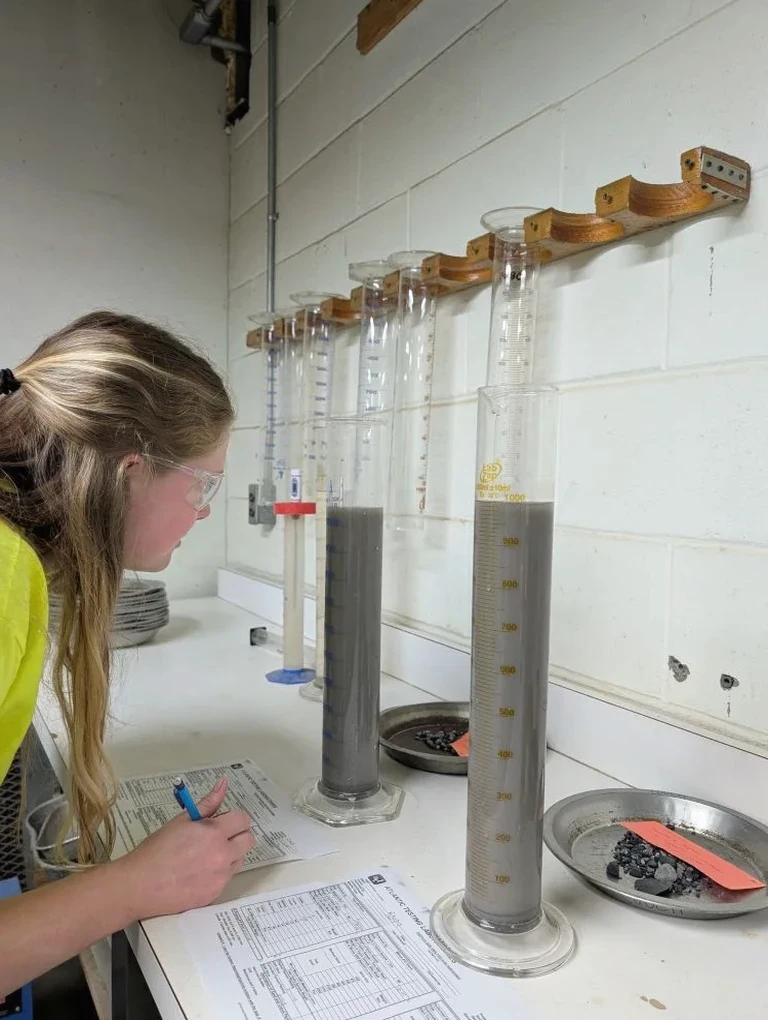
Sheffield’s road network climbs over 1,200 kilometres across seven hills and five river valleys, with average annual rainfall exceeding 800 mm saturating the local subgrades. When the Don Valley floor meets the Millstone Grit slopes of the Pennine fringe, bearing capacity can shift dramatically within a single site—what holds firm on sandstone-derived gravel may pump and rut on the silty clay pockets left by glacial meltwater. The laboratory CBR test gives engineers a repeatable, soaked-condition measurement of subgrade strength before asphalt or concrete goes down. We run our CBR programme inside a UKAS-accredited soil mechanics lab in Sheffield with temperature-controlled soaking tanks, automated loading frames, and surcharge rings set to match the finished pavement depth. For sites where the natural ground raises doubts, we often pair the CBR work with a CBR field assessment to cross-check insitu compaction against the laboratory benchmark before the paver arrives.
A soaked CBR of 2% versus 5% can be the difference between a 300 mm capping layer and a 600 mm one—on a kilometre of estate road that’s sixty lorry movements of imported stone.
Local geotechnical context
The most expensive mistake we see on Sheffield sites is the contractor who runs a CBR on a sunny Monday morning, gets an air-dried strength of 12%, and assumes the formation is good to go—then six months later the winter water table rises into the subgrade and the estate road heaves and cracks along the centreline. A CBR test that skips the four-day soak is not a design value; it’s a snapshot of luck. We’ve pulled cores from failed pavements in Norton Lees and Gleadless Valley where the laboratory CBR on properly soaked samples would have flagged a sub-2% result, triggering the need for a stabilised capping layer or a geogrid-reinforced sub-base. The soaked CBR also feeds directly into the TRL Road Note 29 and DMRB CD 225 pavement thickness design charts—undercall the CBR by even one percentage point and the asphalt binder course may be 30 mm too thin for the design traffic. For sites on the Coal Measures clays, we recommend running a Proctor compaction suite alongside the CBR so the moisture-density relationship is tied to the same material batch, avoiding the common mismatch where the compaction spec and the CBR sample come from two different borrow pits.
Questions and answers
How much does a laboratory CBR test cost in Sheffield?
A single-point soaked CBR test to BS 1377-4 typically ranges from £100 to £180, depending on whether it is a remoulded sample or an undisturbed core, and how many compaction points are included in the package. Most Sheffield road projects need three CBR points per material type, so the total lab cost for a typical residential estate road subgrade assessment falls between £300 and £540.
Why does the CBR test need a 96-hour soak?
The four-day soak simulates the worst-case groundwater condition the subgrade will experience over the pavement’s design life. Sheffield’s high rainfall and perched water tables on the Coal Measures mean subgrades frequently become saturated in winter; a soaked CBR value represents that critical state, while an unsoaked test can overestimate strength by a factor of two or three, leading to under-designed pavement thickness.
Can you test site-won material or does it have to be imported stone?
We test both. For Section 38 adoptions in Sheffield, the council typically wants CBR results on the actual formation soil, not just the imported capping. We can run CBR on bulk disturbed samples you deliver to the lab, or on undisturbed cores taken from trial pits. The remoulded method is standard for earthworks because it gives a repeatable worst-case density condition.
How quickly can I get CBR results for a Sheffield road job?
The 96-hour soak is mandatory under BS 1377-4, so the absolute minimum turnaround is five working days from sample receipt—four days for soaking plus one day for penetration testing and reporting. If you also need Proctor compaction and classification tests to complete a Series 600 package, allow seven working days. We can sometimes expedite the reporting phase but cannot reduce the soak time without compromising the test’s validity.