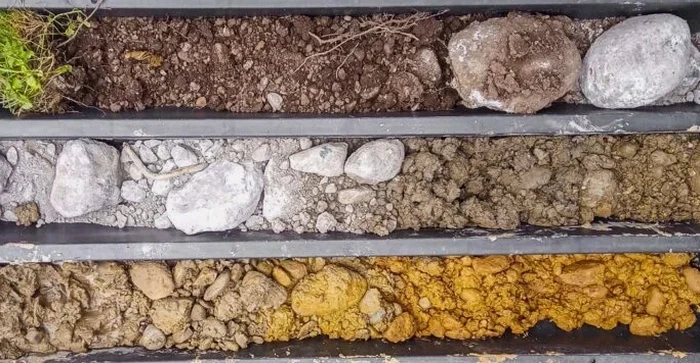
Sheffield’s topography throws up a unique challenge on almost every site: over 60% of the city sits on slopes exceeding 5 degrees, and the underlying geology can switch from sandstone to glacial till within the length of a single foundation. Before committing to a piling or footing design, an exploratory test pit gives you the one thing boreholes sometimes miss: a direct, visual inspection of the ground profile. We open up the near-surface layers so you can see the actual soil fabric, check for buried obstructions, and confirm the depth to competent bearing strata. In former industrial zones like Attercliffe or along the River Don, these excavations also reveal whether old foundations, backfilled cellars, or contaminated made ground are lurking beneath the grass. Combining an exploratory test pit with a CBR assessment for road pavement helps developers tie ground truth to pavement design parameters on the same investigation day.
A 4-metre test pit in Walkley revealed a 1.8 m lens of colluvium sitting directly over weathered mudstone: the foundation design changed from shallow pads to a ground beam within 24 hours.
Questions and answers
How much does an exploratory test pit cost in Sheffield?
For a standard machine-excavated pit up to 3.5 metres deep, including logging, photography, and a factual report, costs typically fall between £340 and £680. The price varies with access constraints, traffic management requirements, and whether you need additional testing like BRE 365 infiltration measurements. A site with very tight access in areas such as Crookes or Broomhill may require a smaller excavator and additional hand-digging, which shifts the cost toward the upper end.
How deep can you go with a test pit in Sheffield's ground conditions?
Most pits reach between 2.5 and 4.5 metres before we hit practical limits. In the sandstone that underlies much of the western suburbs, excavation often stops at the top of the weathered rockhead because the excavator bucket can no longer break out material efficiently. In the alluvial silts and sands of the Don Valley, depth is usually limited by groundwater ingress and the need for hydraulic shoring beyond 1.2 metres.
Do I need a test pit if I already have a borehole log?
Often yes, because a borehole gives you a vertical profile at a single point, but it doesn’t show lateral variability, buried structures, or the true character of the near-surface fill. We have seen sites in Kelham Island where two boreholes 8 metres apart missed a 2-metre-wide brick-lined well that the test pit caught immediately. For foundation design, a pit lets your engineer walk down and see the bearing stratum, which reduces the uncertainty that drives over-design.