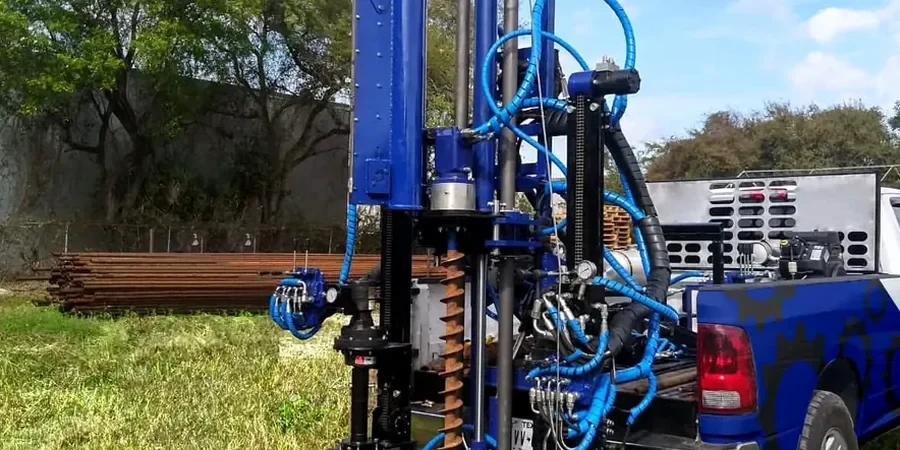
Last year we were called out to a site on the old industrial corridor near Attercliffe, where a developer wanted to put up a six-storey mixed-use block. The borehole logs showed the usual Sheffield fill—brick fragments, ash, and some very soft silts—but nobody really knew what was sitting at depth until we ran the SPT. The split spoon came back with N-values jumping from 4 to 32 at around 7 metres, right where the Millstone Grit was starting to weather into a dense gravelly sand. That kind of contrast is exactly why we rely on the SPT in this city; you can correlate the blow counts directly with the local geology and make a sensible call on whether shallow footings will work or if you need to look at piling solutions. In our laboratory we process the recovered samples alongside the penetration data, so the client gets both a strength profile and a visual description of every change in stratum.
In Sheffield's post-industrial ground, the SPT doesn't just give you a number—it tells you whether you're in natural Grit or reworked colliery spoil, and that distinction matters for settlement calculations.
Local geotechnical context
Sheffield's population of around 580,000 lives on one of the most geologically varied footprints in England, and the risk of skipping a proper SPT programme shows up most often on the hillside sites in Crookes, Walkley, and Nether Edge. Those slopes are underlain by mudstone and thinly bedded sandstone that weathers to a stiff clay at the surface but retains inclined bedding planes at depth. If you only probe the top two metres, you miss the potential for sliding along relic shear surfaces that formed during the Quaternary. We have seen boreholes where the SPT N-value dropped from 28 to 6 across a single bedding plane, and that weak layer governed the entire slope stability assessment. The other classic Sheffield risk is old mine workings: the Coal Authority records show shallow seams beneath large parts of the east of the city, and a low blow count in a borehole that otherwise sits in competent ground can be the first sign of a collapsed pillar or an undocumented shaft. Without that penetration log, you are designing blind.
Questions and answers
What does an SPT test cost in the Sheffield area?
For a standard cable percussion borehole with SPTs at regular intervals, you are typically looking at £480 to £610 per borehole, depending on access, depth, and whether we are drilling through made ground or natural strata. This includes the rig, operator, engineer logging, and the lab classification of all recovered samples. Sites with difficult access—such as steep gardens in Fulwood or tight backland plots in Heeley—may need a smaller rig and a bit more time, which can shift the price toward the upper end of that range.
How deep do you normally go with SPT boreholes in Sheffield?
Most investigations in the city reach between 10 and 25 metres. On the flat ground along the Don Valley, we often stop around 15 metres once we have proven competent Grit or limestone. On the hillsides, we usually go deeper—20 to 25 metres—to confirm that the mudstone is continuous and not just a large block sitting on a weaker layer. For high-rise schemes, we have gone to 30 metres, but that is less common in Sheffield than in Manchester or Leeds.
How do you interpret SPT N-values in Sheffield's made ground?
Made ground in Sheffield is tricky because it can contain everything from furnace slag to old sandstone setts. We treat N-values in fill with caution and never use them directly for bearing capacity without context. Instead, we log the recovered material carefully, note any obstructions or voids, and use the SPT mainly to identify the base of the fill. Once we are into natural ground, the N-values become far more reliable for design. We also cross-check with nearby borehole records from the BGS and Coal Authority to understand what the fill is likely composed of.
What is the difference between SPT and CPT for Sheffield sites?
The SPT gives us a soil sample back from every test depth, which is invaluable in Sheffield's mixed ground where you might pass from glacial till into Coal Measures shale in the same borehole. The CPT gives you a continuous profile of cone resistance and pore pressure but no physical sample. In practice, we use the SPT as the primary tool for most Sheffield investigations because the geology is so variable, and we supplement it with a CPT only on larger, flatter sites like the former airport or the Lower Don Valley where the ground is more uniform and a faster push makes sense.