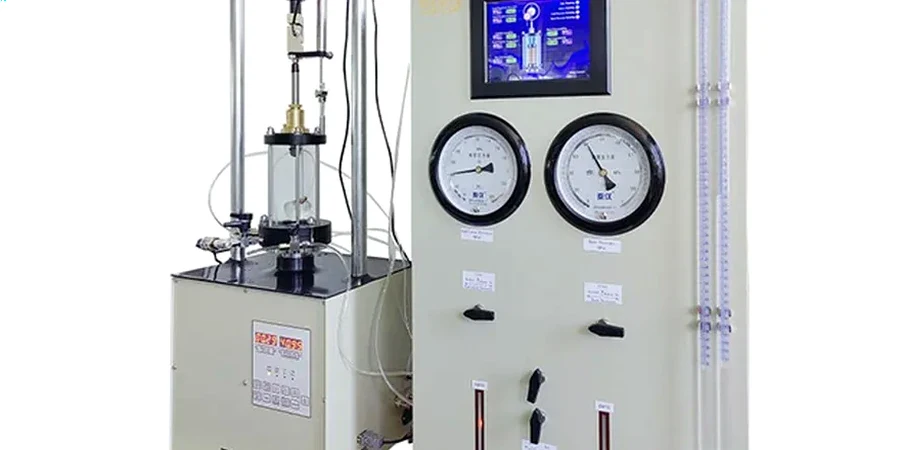
In Sheffield, the role of geotechnical laboratory testing is fundamental to de-risking construction and civil engineering projects. This category encompasses the physical and mechanical analysis of soil and rock samples recovered from site investigations. By simulating ground conditions in a controlled environment, we move beyond visual classification to quantify how the ground will actually behave under load, when saturated, or when compacted. This data forms the backbone of safe, economical foundation design, earthworks specification, and slope stability assessment, ensuring structures from residential extensions to major infrastructure are built on a thoroughly understood geological base.
Sheffield's unique and challenging geology makes rigorous laboratory testing indispensable. The city straddles the Carboniferous Millstone Grit series to the west, known for its strong but fractured sandstones, and the softer Pennine Lower Coal Measures Formation to the east, characterised by cyclical sequences of mudstones, siltstones, and historically worked coal seams. Superficial deposits add further complexity, with variable glacial tills, alluvial sands and gravels in the Don and Sheaf river valleys, and pockets of compressible peat on the upland fringes. Legacy issues from centuries of mining and industrial activity mean made ground and contaminated fill are widespread, requiring careful characterisation of their geotechnical and chemical properties before any development can proceed.
All testing within this category is conducted in strict accordance with the relevant British Standards, primarily the BS 1377 series (Methods of test for soils for civil engineering purposes) and BS EN ISO 17892 for geotechnical investigation and testing. Depending on the project's nature, testing programmes are designed to meet the requirements of Eurocode 7 (BS EN 1997-2), which mandates specific levels of investigation and derived ground parameters for different design situations. This adherence ensures that results are defensible, repeatable, and accepted by local authorities, the Environment Agency, and NHBC warranty providers, forming a legally robust part of the Ground Investigation Report.
The insights from a laboratory testing programme are critical across Sheffield's project spectrum. For a city centre high-rise on a tight brownfield site, advanced strength and stiffness tests like a triaxial test are essential for predicting settlement and designing deep foundations that navigate past old mine workings. For a housing development on a sloping site of glacial till, effective stress shear strength parameters are vital for slope stability analysis. Even for a straightforward house extension, a simple classification suite including grain size analysis (sieve + hydrometer) confirms the soil type and its susceptibility to volume change, directly informing the foundation depth required by Building Regulations. Road and sewer adoption schemes rely on compaction-related tests to sign off on engineered fill, while remediation projects use leachate testing to validate the clean-up of contaminated land.
The process typically begins with a site investigation contractor taking disturbed or undisturbed samples from boreholes or trial pits. These are securely transported to the laboratory with chain-of-custody documentation. On arrival, samples are logged, scheduled for the requested tests, and stored appropriately. You receive a factual report with results, which a geotechnical engineer then interprets into design parameters.
The core standards are BS 1377, which details methods for classification, compaction, and shear strength tests, and BS EN ISO 17892, which aligns UK practice with international standards for index, strength, and compressibility testing. Testing schedules are designed to satisfy the investigation requirements of Eurocode 7 (BS EN 1997-2), ensuring the derived ground parameters are suitable for geotechnical design.
Results provide the fundamental soil parameters—such as undrained shear strength, effective friction angle, and compressibility—that are direct inputs into bearing capacity and settlement calculations. For instance, a triaxial test on a glacial till sample defines the shear strength for slope stability, while oedometer tests predict the settlement of shallow foundations on alluvium, directly influencing the foundation type and depth chosen.
In-situ tests like SPTs or CPTs provide continuous profiles and are excellent for stratigraphy, but they measure response indirectly. Laboratory tests on high-quality samples are essential to directly measure fundamental properties like effective stress shear strength, permeability, and consolidation characteristics under precisely controlled drainage conditions. This combined approach is crucial in Sheffield's complex geology of mixed glacial and post-glacial deposits.
We serve projects across Sheffield and its metropolitan area.