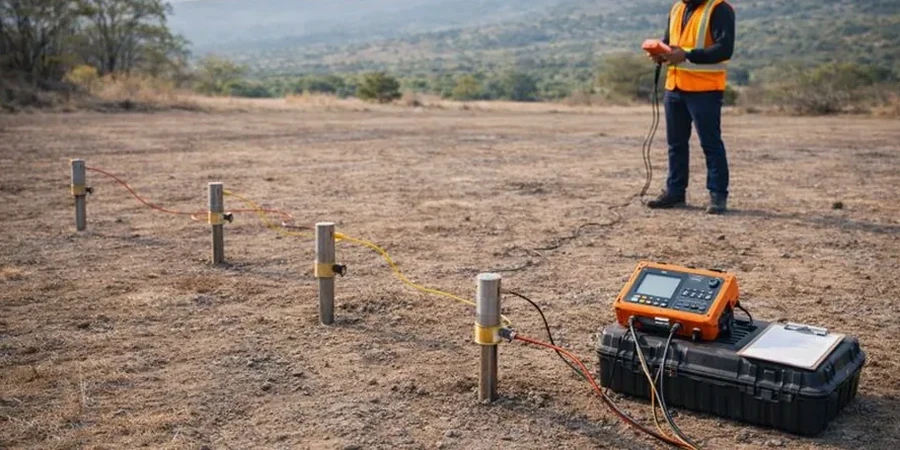
In Sheffield, the transition from the sandstone ridges to the shale valleys of the Don basin creates a subsurface that rarely reads the same twice. You might hit competent rock at three metres on one plot, then find waterlogged alluvium pushing past six metres just two streets away. This is where a vertical electrical sounding cuts through the guesswork. We run resistivity arrays that map the contact between the Millstone Grit and the overlying drift deposits, giving you a clear depth profile without excavation. The data feeds directly into foundation design, helping engineers decide between shallow footings and deeper solutions. For sites near the confluence of the Sheaf and Don, where historic fill masks the natural strata, a test pit investigation often complements the resistivity profile by providing a direct look at the upper two metres of made ground.
A single VES station can resolve the depth to competent sandstone across most of Sheffield's post-industrial valleys without breaking ground.
Process and scope
British Standard BS 5930:2015+A1:2020 governs the investigation of potentially contaminated land and natural ground variability, and our resistivity protocols follow its requirements for geophysical survey density. We use a Schlumberger array for the vertical electrical sounding because it delivers strong signal-to-noise ratios at the depths Sheffield projects typically need—10 to 50 metres below ground level. The method works by injecting DC current through two outer electrodes and measuring the potential between two inner probes, then expanding the electrode spacing stepwise to sample progressively deeper layers. On the steeper slopes of Crookes or Walkley, where the head of the Loxley Edge rock can sit just under the topsoil, the resistivity contrast between the sandstone and the overlying weathered zone is sharp enough to pick up an unconformity within half a metre. Each VES station produces an apparent resistivity curve that we invert using 1D layered-earth models, constrained by any borehole or trial pit data available on the parcel.
Questions and answers
How much does an electrical resistivity survey cost in Sheffield?
A single vertical electrical sounding station with interpretation typically runs between £550 and £730, depending on the array length and site access conditions. A full 2D ERT line across a standard residential parcel starts around £850. We provide a fixed quote after reviewing the site location and the depth of interest.
How deep can a VES survey see in the Sheffield area?
With a maximum electrode spacing of AB/2 = 150 metres, we can achieve an investigation depth of roughly 50 to 60 metres in favourable ground. The actual penetration depends on the near-surface resistivity—conductive clay-rich drift attenuates the signal sooner, while dry sandstone lets the current reach deeper targets.
Do you need vehicle access to run a resistivity survey?
For most residential and light commercial sites in Sheffield we carry portable equipment—electrodes, cables, and a small resistivity meter that fits in a backpack. Steep gardens in areas like Nether Edge or Walkley are manageable. We only need vehicle access for long 2D lines that require hundreds of metres of cable and a larger power source.