Sheffield's geology tells a story of ancient rivers, tropical swamps, and grinding ice sheets, leaving a legacy that directly shapes every foundation poured in the Steel City. Much of the western suburbs sit atop the Millstone Grit, a Carboniferous sandstone that provides excellent bearing capacity but weathers into loose, blocky head deposits on steeper slopes. The eastern districts, however, rest on the notoriously variable Pennine Lower Coal Measures, a repeating sequence of mudstones, siltstones, and sandstones layered like a geological millefeuille. Commissioning a soil mechanics study here is not a box-ticking exercise; it is an interrogation of a complex post-glacial landscape where competent rock can transition to soft clay within a single building footprint. Our laboratory, which operates under ISO/IEC 17025:2017 accreditation for geotechnical testing, applies the full framework of BS 5930:2015+A1:2020 and Eurocode 7 (BS EN 1997-1:2004+A1:2013 and BS EN 1997-2:2007) to decode these transitions, moving beyond simple classification to predict mechanical behaviour under load. Understanding the residual strength of a slickensided mudstone or the collapse potential of a loessic brickearth deposit demands more than a standard suite of index tests; it requires a forensic approach that connects the site's Quaternary history to its engineering parameters.
In Sheffield's Coal Measures, the difference between a competent sandstone and a weathered mudstone can be less than a metre, and the consequence of misclassifying that transition is a foundation designed for the wrong ground.
Process and scope
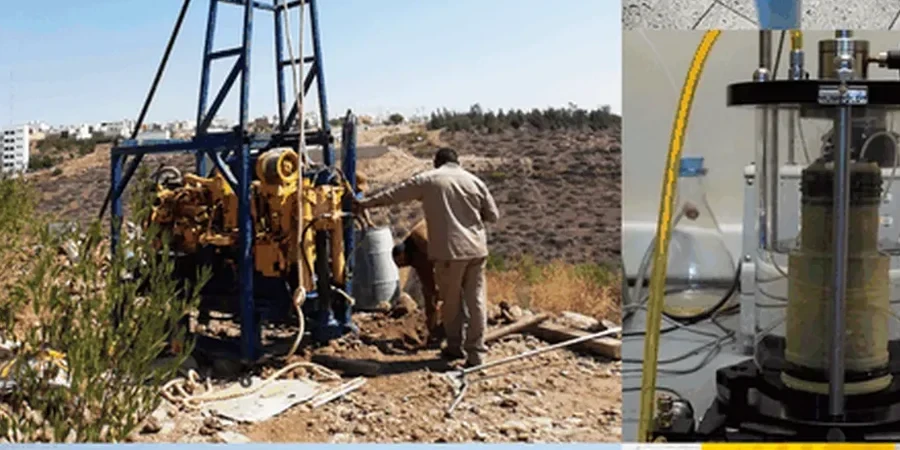
A Sheffield soil mechanics study typically begins with cable percussive or rotary drilling depending on the depth to rockhead, which can undulate wildly across the city, from outcropping gritstone pavements near Ringinglow to buried drift-filled channels over 20 metres deep in the Don Valley. The investigation often integrates laboratory testing on high-quality undisturbed samples, which are notoriously difficult to recover from the weathered mudstones of the Pennine Middle Coal Measures. In these materials, the team prioritises multistage triaxial testing (BS EN ISO 17892-9:2018) to establish effective stress parameters, because relying on drained peak strength alone can be misleading where progressive slope failures have historically reactivated along pre-existing shear surfaces. For the alluvial deposits along the River Sheaf, we frequently couple oedometer consolidation tests with
triaxial tests to quantify settlement rates, while in areas of historic fill, a
test pit campaign helps map the extent of buried industrial debris common in Sheffield's Kelham Island and Neepsend districts. The laboratory programme is always designed iteratively, with the scope refined as the ground model evolves from the first borehole logs.
Local geotechnical context
The climatic reality of South Yorkshire, with over 830 mm of annual rainfall and persistent saturation during the autumn and winter months, fundamentally alters the risk profile of any earthworks or foundation design in Sheffield. The city's slope stability problems are legendary, with the Seven Hills topography creating a natural laboratory for shallow translational landslides in the weathered zone where colluvium mantles the bedrock. A soil mechanics study in this context must focus on the residual friction angle of overconsolidated clays and the pore pressure response during prolonged wet periods, because a slope that stands safely in August can fail in February when suction pressures dissipate. Equally critical is the assessment of swelling potential in the mudstone sequences; repeated wetting and drying cycles in the upper two metres can cause ground heave differentials sufficient to crack lightly-loaded strip footings. The investigation also addresses the risk of encountering mine entries and shallow coal workings, a legacy of Sheffield's mining heritage that demands careful interpretation of borehole data to avoid catastrophic subsidence during the operational life of the structure.
Questions and answers
What does a soil mechanics study typically cost for a Sheffield residential extension?
For a single-storey rear extension on a typical Sheffield suburban plot, the investigation and reporting usually falls between £2,430 and £3,680, depending on access constraints, depth to competent bearing strata, and whether laboratory testing beyond basic classification is required to satisfy building control.
How does the Coal Measures geology affect foundation design in Sheffield?
The Coal Measures are a rhythmic succession of mudstones, siltstones, and sandstones, which means bearing capacity and settlement characteristics can change dramatically across a site. Mudstones are particularly sensitive to water; their undrained shear strength drops significantly when exposed during construction, and they can swell upon unloading, requiring careful specification of founding depths and protection of formation levels during wet weather.
Why is slope stability a major concern for Sheffield developments?
Sheffield's topography, with its steep valley sides carved into the Pennine foothills, combines with the weathered nature of the near-surface bedrock to create conditions where shallow landslides are common. A soil mechanics study quantifies the residual shear strength along relict slip surfaces and models the effect of prolonged rainfall infiltration, which reduces the soil suction that normally holds slopes together during drier months.
Do I need a soil mechanics study if I am building on a site with a known mining history?
Yes, and it is not just advisable, it is effectively mandatory. The investigation must go deeper than standard boreholes to prove the absence of unrecorded shallow workings, which are widespread across Sheffield's eastern postcodes. The soil mechanics analysis then focuses on the bulking factor of collapsed mine debris and the potential for future subsidence migration to the surface, which standard foundation design does not account for.