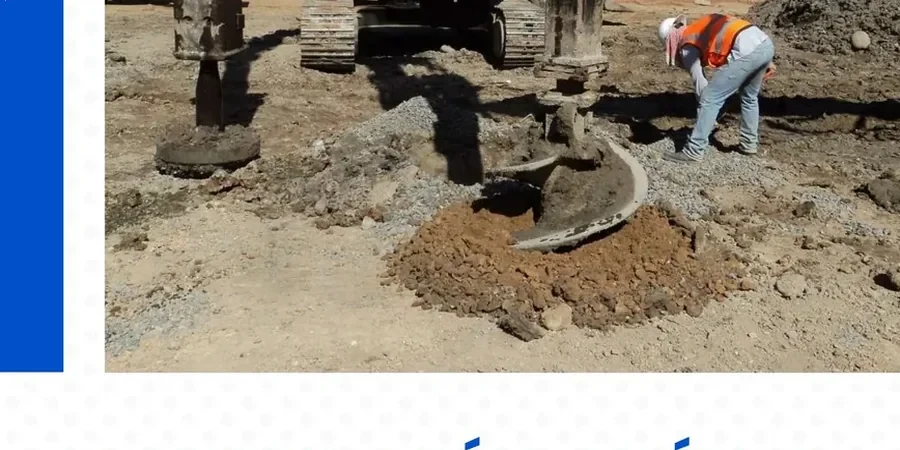
The rig that rolls onto a Sheffield site often looks straightforward enough, but the engineering behind what it installs is where the real work happens. A vibroflot or top-feed piling rig sinking stone columns into the Don Valley alluvium isn’t just pushing gravel into the ground; it’s executing a ground improvement scheme that has to compensate for metres of soft silts and clays overlying the Coal Measures at depth. Our stone column design process starts with a thorough review of the ground investigation data, because in Sheffield the interface between weathered mudstone and river terrace deposits can vary sharply across a single site. We combine that with the structural loads to size the columns, set the spacing, and specify the gravel gradation so the treated ground delivers the bearing capacity and settlement control the project requires. The approach ties directly into the vibrocompaction logic for granular fills, but for cohesive soils the column stiffness contrast is what does the heavy lifting.
A well-designed stone column transfers stress to the stiffer column while the surrounding soil consolidates and gains strength over time.
Process and scope
The Pennine fringe weather means Sheffield sites can be saturated for months, and that changes how a stone column design has to perform. In the Don Valley, where post-glacial clays hold water and the water table sits close to the surface, the columns act as vertical drains during consolidation while also reinforcing the soil mass. We specify clean, angular crushed stone, typically 40–75 mm, because rounded gravel tends to lose interlock under repeated loading from industrial units or distribution centres. Our designs follow BS EN 1997-1:2004 Design Approach 1, checking both the ultimate limit state of the column and the serviceability limit state of the composite ground, with partial factors aligned to UK National Annex values. For sites near the River Sheaf or Porter Brook, we also assess the risk of fines migration into the column core and adjust the filter criteria. Every design includes a load test specification and acceptance criteria so the contractor has clear targets during installation.
Local geotechnical context
The contrast between the shallow rockhead of the western suburbs and the deep alluvium of the Lower Don Valley couldn’t be sharper. In places like Attercliffe or Tinsley, where the former marshland has been built on and rebuilt over 150 years, made ground can reach six metres thick, with brick rubble, ash, and old foundations mixed into soft silt. Designing stone columns there means accepting that the upper column section will have lower confinement, so we deepen the columns into competent strata and sometimes add a load transfer platform at the surface. Compare that to a site in Fulwood or Ranmoor, where the glacial till is stiffer and the columns are shorter—the design logic flips from settlement control to bearing capacity improvement. Sheffield’s post-industrial land also carries the risk of contaminated leachate, so we specify geotextile encasement where chemical attack on the stone could reduce long-term permeability or strength.
Questions and answers
What does stone column design cost for a typical Sheffield site?
For a detailed design package, the fee is usually between £1,060 and £4,220, depending on the size of the treated area, the complexity of the ground conditions, and the number of columns to be designed. A feasibility study sits at the lower end of that range, while a full design with verification support sits at the upper end.
How do stone columns compare to vibrocompaction in Sheffield?
Vibrocompaction works well in granular fills, but much of Sheffield’s soft ground is cohesive — silts and clays — where compaction alone cannot drain pore pressures fast enough. Stone columns create a stiffer composite mass through reinforcement and drainage, so they are the right choice for most Don Valley alluvial sites.
What depth can stone columns reach in Sheffield ground?
Column depth is dictated by the depth to competent bearing strata. In the Lower Don Valley, columns commonly reach 6 to 12 metres to penetrate the alluvium and seat into the underlying Coal Measures or a dense glacial till. We design each column length based on the CPT or borehole log at that grid point.
Do you need a ground investigation before stone column design?
Yes. The design relies on knowing the undrained shear strength, compressibility, and groundwater profile of the soils to be treated. We normally require CPTu data or good-quality borehole logs with lab testing to BS 5930 standards before starting the design.
How do you verify the stone columns are working?
We specify zone load tests on a percentage of the columns to measure load-settlement behaviour, plus post-treatment CPT or SPT profiles between columns to confirm the soil has densified or consolidated as predicted. The acceptance criteria are set in the design report before installation starts.