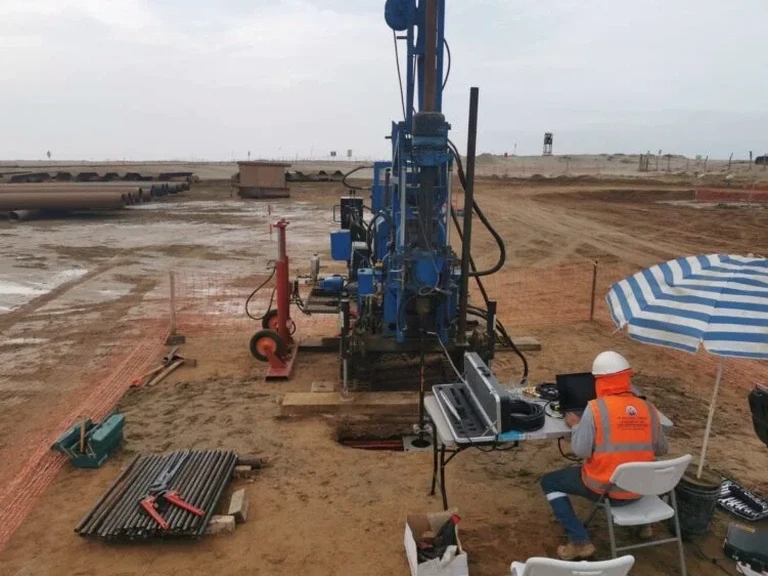
Sheffield's subsurface rarely reads the textbook. You start drilling in the Don Valley and hit soft alluvium over gravel; move half a mile west toward Broomhill and the rig is fighting stiff glacial till overlying weathered shale. Cone penetration testing cuts through that variability with a continuous resistance profile that boreholes alone cannot deliver. The team runs a 20-tonne CPT rig with a 15 cm² electric cone, recording tip resistance, sleeve friction, and dynamic pore pressure at 10 mm intervals, all compliant with BS EN ISO 22476-1. In ground where sampling disturbance in brittle clays or loose silts can mislead the lab, the piezocone gives you a near-undisturbed read of drainage behaviour and stress history. For sites near the River Sheaf or over former steelworks backfill, we often pair the CPT with resistivity surveys to map buried obstructions before pushing the cone.
A single CPT sounding replaces half a dozen disturbed samples with a continuous digital log of strength, stratigraphy, and pore pressure response.
Local geotechnical context
The geological contrast between Sheffield's west and east sides creates two distinct CPT risk profiles. In the western suburbs — Fulwood, Ranmoor, Lodge Moor — the till cover is thin and cone refusal on sandstone bedrock can occur abruptly at 3–6 m, limiting penetration depth but providing a reliable refusal criterion for end-bearing piles. East of the M1, across Attercliffe and Darnall, thick alluvial and head deposits allow deeper pushes but pore pressure dissipation tests often reveal under-consolidated silts that will settle significantly under embankment loading. The real hazard sits in the post-industrial fill across the Lower Don Valley: unrecorded slag heaps, brick rubble, and occasional voids from collapsed mine workings that can damage the cone or produce erratic tip resistance spikes. Pre-CPT desk study including historical Ordnance Survey maps and Coal Authority records is non-negotiable here. Where the CPT profile shows a negative friction ratio in soft clay with rising u2, we flag potential sample disturbance in any follow-up boreholes and recommend dissipation testing to confirm the operational drainage condition.
Questions and answers
What depth can a CPT rig reach in Sheffield's geology?
In the alluvial deposits along the Don and Sheaf valleys, 20–28 m is routinely achievable with a 200 kN rig. On the western till-covered slopes, cone refusal on sandstone bedrock frequently limits depth to 4–10 m. Pre-survey geological mapping helps set realistic target depths for each sounding location.
How much does CPT testing cost per sounding in Sheffield?
For standard CPTU soundings within the Sheffield area, rates typically range from £140 to £220 per metre of penetration, depending on depth, access conditions, and whether dissipation tests are included. Mobilisation is quoted separately and varies with the number of soundings and site location relative to the city centre.
Can CPT replace boreholes entirely on a Sheffield site?
CPT provides a continuous strength and stratigraphy profile but cannot recover physical samples for visual classification or laboratory testing. On straightforward sites with well-characterised geology, a CPT grid may reduce the number of boreholes required. For contaminated land or where shear strength needs triaxial confirmation, a hybrid programme of CPT soundings plus targeted boreholes is standard under BS 5930:2015+A1:2020.
How do you interpret soil type from CPT data alone?
Soil behaviour type is inferred from the normalised cone resistance (Qt) and friction ratio (Rf) using the Robertson (1990) SBTn chart, updated in 2010. The pore pressure parameter Bq further discriminates between drained, partially drained, and undrained behaviour. However, the classification is behavioural, not textural — a high-friction-ratio clay can occasionally plot as silt if it is overconsolidated, so local geological context is always integrated into the interpretation.