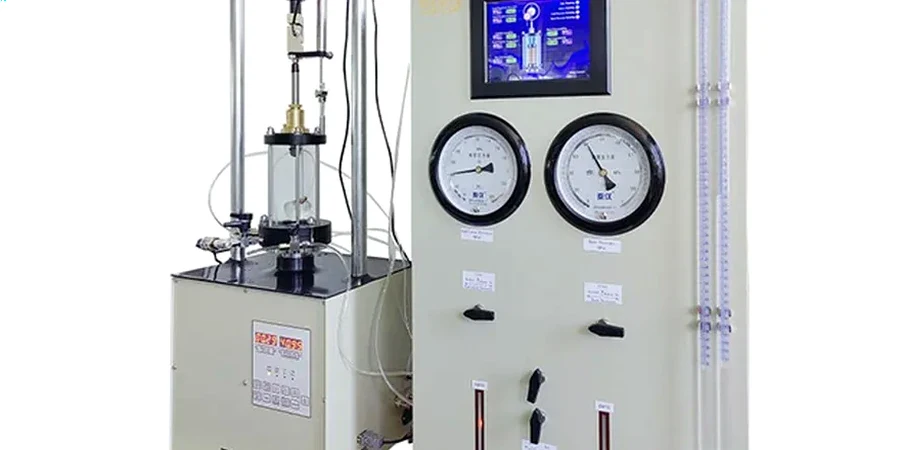
Sheffield sits on a complex mix of Carboniferous millstone grit, shale, and sandstone, but the real challenge for foundation engineers lies in the valley alluvium and weathered head deposits along the Don and Sheaf rivers. Cohesive fill from the city's industrial past masks variable ground conditions that simple index tests cannot resolve. A triaxial test measures drained and undrained shear strength under controlled confining pressures, reproducing the stress state a soil element will experience beneath a new structure. The laboratory in South Yorkshire runs consolidated undrained (CU) and consolidated drained (CD) triaxial compression on undisturbed Shelby tube samples extracted from depths up to 30 metres. For projects on slopes overlooking the Porter Brook, the stress path method in a CD test provides the effective friction angle needed for a reliable slope stability analysis. When the brief demands continuous strength profiles in soft alluvium before opting for sampling, the team often pairs the triaxial with an in-situ CPT test to select the most critical layers for advanced testing.
A multi-stage triaxial test on Mercia Mudstone weathered clay delivers the effective cohesion and friction angle required for Eurocode 7 Design Approach 1 in Sheffield's variable ground.
Process and scope
The triaxial cell used for Sheffield projects is a Bishop & Wesley-type hydraulic apparatus with a 150 mm diameter specimen capacity, equipped with internal load cells and mid-plane pore pressure transducers. This setup eliminates ram friction and system compliance errors that plague older external measurement systems. A typical multi-stage CU test on a saturated clay from the Mercia Mudstone weathered zone runs three consolidation stages at effective confining stresses of 100, 200, and 400 kPa, followed by undrained shear at 0.05 mm/min axial strain rate. Back pressure saturation ensures a Skempton B-value above 0.95 before shearing. The software logs deviator stress, excess pore pressure, and axial strain at 1-second intervals, generating Mohr-Coulomb failure envelopes for both total and effective stress. For granular materials like the Chester Formation sands found beneath Kelham Island redevelopment sites, consolidated drained tests with volume change measurement yield the critical state friction angle. Every test includes a particle size distribution check post-shear to confirm that grain crushing has not affected the measured strength parameters.
Questions and answers
How much does a triaxial test cost for a Sheffield project?
A standard multi-stage CU triaxial test with isotropic consolidation and pore pressure measurement ranges from £1,520 to £2,410 per specimen, depending on the number of consolidation stages and specimen diameter. The price includes specimen preparation, saturation, shearing, and a full interpretive report with Mohr-Coulomb failure envelopes and stress path plots.
What sample quality is needed for a reliable triaxial test?
Undisturbed samples recovered with thin-walled Shelby tubes or piston samplers (Class 1 quality per BS EN ISO 22475-1) are essential. Tube samples must be sealed with wax and transported in foam-lined crates to the laboratory within 48 hours. Disturbed bag samples or SPT split-spoon samples are unsuitable for triaxial testing because the in-situ fabric and stress history are lost.
How many triaxial tests does a typical Sheffield site require?
The number depends on the geological variability and the design risk category per Eurocode 7. For a Geotechnical Category 2 project on a single geological unit, a minimum of three CU tests from different boreholes is recommended. Sites crossing the boundary between the Millstone Grit and the alluvial deposits may need six or more tests to capture the strength contrast between weathered rock and soft clay.
Can you test granular soils like the Chester Formation sands in a triaxial cell?
Yes, consolidated drained triaxial tests on reconstituted sand specimens are routine. The sand is compacted to the field density in a split mould, saturated under back pressure, and sheared slowly to allow full drainage. The effective friction angle (φ') and the critical state line are determined for use in advanced constitutive models for deep excavation and tunnel design in Sheffield.