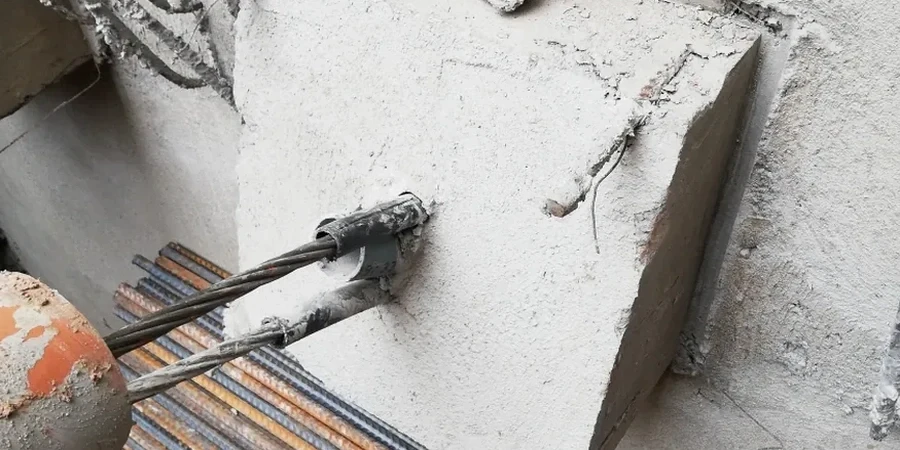
Sheffield’s topography is defined by its seven hills and the deep valleys carved by the rivers Don, Sheaf, and Loxley, which exposes a geological sequence dominated by Carboniferous Coal Measures. These interbedded sandstones, siltstones, and mudstones weather rapidly when cut, creating a recurring challenge for permanent retaining structures. The cyclical wetting and drying of the Pennine climate accelerates degradation of the near-surface mudstone, meaning that anchor design must account for a potentially softening bond zone over the structure’s life. In our experience across sites from Kelham Island to Hillsborough, a purely textbook approach rarely works because the residual strength of the weathered mudstone varies significantly over short distances. A rigorous ground investigation programme, often combining rotary drilling with SPT drilling to recover samples for classification, becomes essential before selecting an anchor type and determining the fixed length. The distinction between active anchors, which are tensioned to pre-compress the structure and limit movements, and passive anchors, which mobilise resistance only as the ground deforms, is critical here because of the sensitivity of adjacent Victorian-era infrastructure to any excavation-induced displacement.
In Sheffield’s Coal Measures, the bond strength of an anchor in weathered mudstone can degrade by up to forty percent over twenty years if the water regime is not controlled during construction.
Local geotechnical context
BS 8081:2015 and the geotechnical design provisions of Eurocode 7 (BS EN 1997-1:2004) frame the core requirements for anchor design, but the particular risk in Sheffield relates to the legacy of shallow coal mining. Unrecorded mine entries and pillar-and-stall workings exist beneath many development sites, and intersecting one during anchor installation can lead to sudden grout loss, collapse of the borehole, or long-term corrosion pathways for the tendon. The Coal Authority’s interactive map shows that areas like Crookes, Walkley, and parts of the city centre sit above seams that were worked at depths ranging from fifteen to sixty metres, which frequently coincides with the target depth for retaining wall anchors. A desk study and a seismic refraction survey are often the first steps we recommend to identify potential void locations before any drilling begins. Another risk factor is the presence of pyritic shale within the Coal Measures, which oxidises when exposed and can generate acidic groundwater capable of corroding standard steel tendons if the grout cover is imperfect. This is why a water sampling campaign and a review of the pH and sulphate content of the groundwater form part of the corrosion risk assessment for any permanent anchor installation in the city.
Questions and answers
How much does an anchor design and testing package cost for a typical Sheffield project?
The fee for a design package covering a single retaining wall with four to eight anchors, including the on-site proof testing supervision, typically falls between £780 and £2,800. The variation depends on the number of anchors, the complexity of the ground profile, and whether preliminary investigation data is already available or needs to be gathered.
What is the difference between an active and a passive anchor in a retaining wall?
An active anchor is tensioned after installation to apply a pre-compressive force to the wall, which controls horizontal movement from the outset. A passive anchor is not tensioned; it only develops resistance once the ground begins to move and transfers load to the tendon. In Sheffield, active anchors are generally specified for permanent structures where neighbouring buildings or utilities are sensitive to settlement, while passive anchors are more common in temporary excavations where some controlled movement is acceptable.
How do you verify the capacity of an anchor in weathered mudstone?
The capacity is verified through a staged suitability test on sacrificial anchors before production drilling begins, usually loading up to 1.5 times the design load and measuring creep over a sustained hold period. For production anchors, an acceptance test is performed on every installation, with a pass criterion of less than 2 mm of creep over thirty minutes at the proof load. The results are interpreted against the bond stress assumptions derived from the initial ground investigation log.
Do I need a mining report before installing anchors in Sheffield?
Yes, a Coal Authority mining report is essential for any site where anchors will penetrate beyond five metres depth, because shallow pillar-and-stall workings are widespread across the city. If the report indicates potential workings in the anchor bond zone, a rotary drilling investigation with a recorded penetration rate and flush return is used to confirm the presence of voids before any anchor installation begins.