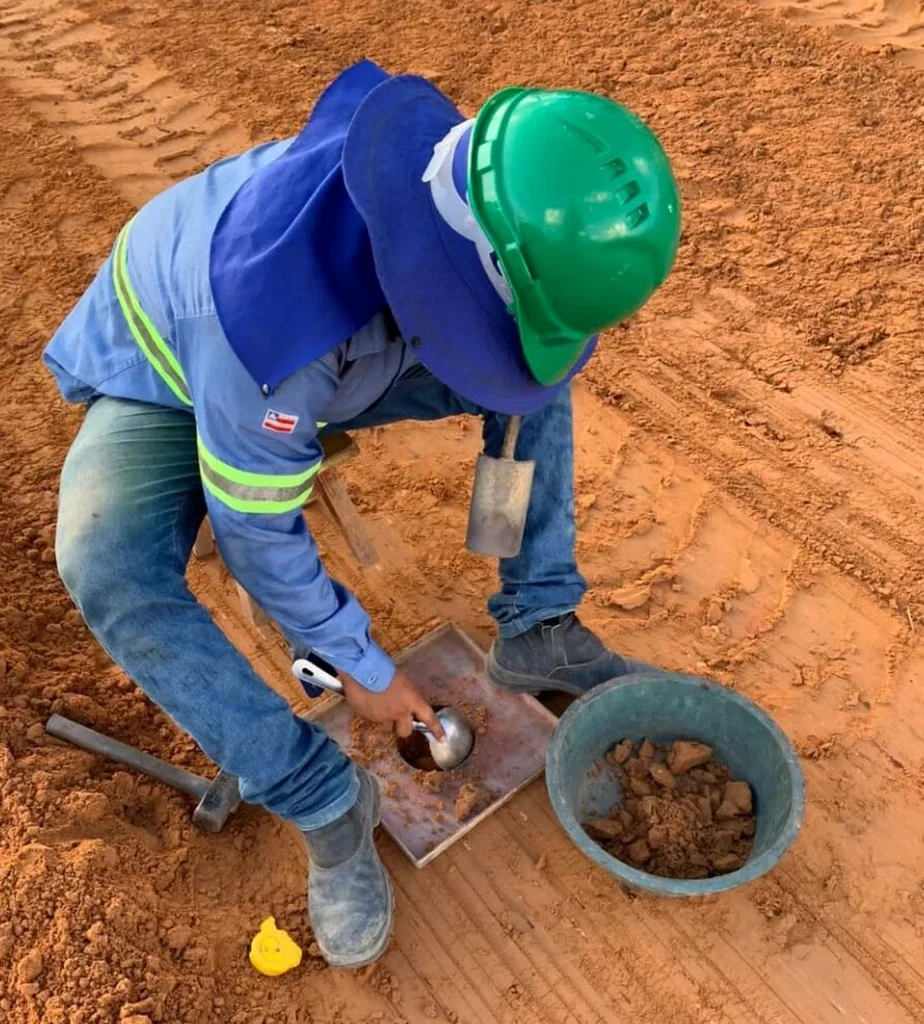
Sheffield sits on seven hills at the confluence of the Don and Sheve — roughly 50 metres above sea level in the city centre, rising to over 400 metres toward the Peak District fringes. This topography means almost every construction site involves cut or fill, and with fill comes the need to verify compaction. The field density test using the sand cone method is the direct, long-established way to confirm that placed material meets specification density. In Sheffield’s mixed ground — Millstone Grit-derived head, glacial till, and alluvium along the Don Valley — density acceptance is not a tick-box exercise. We run the test to BS 1377-9, which governs in-place density by the sand replacement method, and correlate results with Proctor compaction tests to establish the percentage of maximum dry density achieved on site. For deeper formation layers where granular fill is thicker, we complement the sand cone with in-situ permeability testing to confirm drainage characteristics alongside density.
A density figure without the corresponding Proctor curve is just a number — the sand cone test bridges field compaction and laboratory reference.
Process and scope
The sand cone method is straightforward in principle but demands careful execution, especially on weathered Pennine clays that can soften rapidly if exposed. A small circular hole is excavated, all spoil collected, and a calibrated sand of known bulk density is poured in to measure the hole volume. Wet density is then calculated and, with a moisture content determination, converted to dry density. The test works best on well-graded granular fill and stiff clays; it becomes less reliable in very coarse, open-graded stone or saturated silts where hole collapse is a risk. On Sheffield jobs we frequently test Type 1 sub-base for estate roads, engineered fill behind
retaining walls, and formation layers beneath industrial slabs. Our technicians carry calibrated sand jars, base plates, and moisture tins as standard, and every test is referenced to a Proctor curve from the same source material — without that linkage, a density number has no meaning. We record layer thickness, compactor type, and number of passes so the result tells you what to adjust, not just pass or fail.
Questions and answers
What does a field density test with the sand cone cost in Sheffield?
A single sand cone density test in the Sheffield area typically ranges from £90 to £120, depending on site location, number of tests per visit, and whether moisture content determination is done on site or back in the lab. Multiple tests on the same day reduce the per-test cost.
Which British Standard governs the sand replacement method?
BS 1377-9:1990 covers the sand replacement method for determining in-place density. The test is also referenced in the MCHW Series 600 for highway earthworks and in BS EN 1997-2 for geotechnical investigation purposes.
On what types of fill can the sand cone method be used?
The method is suitable for well-graded granular soils, cohesive fills in a firm to stiff state, and crushed rock with a maximum particle size no larger than about one-fifth of the test hole diameter. It is not recommended for saturated, collapsing, or very coarse open-graded materials.
How many density tests are needed per area?
The MCHW Series 600 generally specifies one in-situ density test per 500 square metres per compacted lift, though tighter frequencies may apply for structural fill under foundations or behind retaining structures. We can advise on a testing schedule that meets your specification and satisfies the adopting authority.