← Home · Underground Excavations

Geotechnical Excavation Monitoring in Sheffield: Instrumentation, Data and Site Safety

Together, we solve the challenges of tomorrow.

LEARN MORE →

Sheffield sits in the foothills of the Pennines, where the topography alone demands a serious approach to any cut deeper than a couple of metres. The city climbs from about 30 m AOD near the Don Valley to over 200 m in its western suburbs, and that relief means retained excavations are part of almost every urban project. In our experience, the difference between a smooth dig and a costly delay often comes down to how early the monitoring regime is specified. We look at groundwater response, lateral movement profiles and load transfer into temporary supports, feeding real-time data back to the design team. For projects that involve deep basement boxes or cut-and-cover tunnels, combining monitoring with a deep excavation design review helps catch mismatches between assumed and actual ground behaviour before they turn into non-conformances.

A well-instrumented excavation in Sheffield's Coal Measures can reduce temporary works steel by up to 15 percent because real displacement data lets you justify a less conservative observational approach.

Process and scope

The geology under Sheffield is dominated by the Pennine Lower and Middle Coal Measures — interbedded sandstones, siltstones, mudstones and occasional thin coal seams, all of which weather at different rates. What we see most often is that a cut face that stands perfectly in dry sandstone will start unraveling the moment it hits a water-bearing siltstone band. Monitoring therefore has to capture both pore-water pressure changes and the associated reduction in effective stress. Inclinometers and standpipe piezometers are the backbone of most campaigns, but for sites close to the city's Victorian masonry infrastructure we also add vibration and settlement markers. Where the ground profile suggests loose head deposits over rockhead, a CPT investigation prior to excavation gives us a continuous strength-and-pore-pressure baseline that makes the subsequent monitoring thresholds far more meaningful.
Geotechnical Excavation Monitoring in Sheffield: Instrumentation, Data and Site Safety
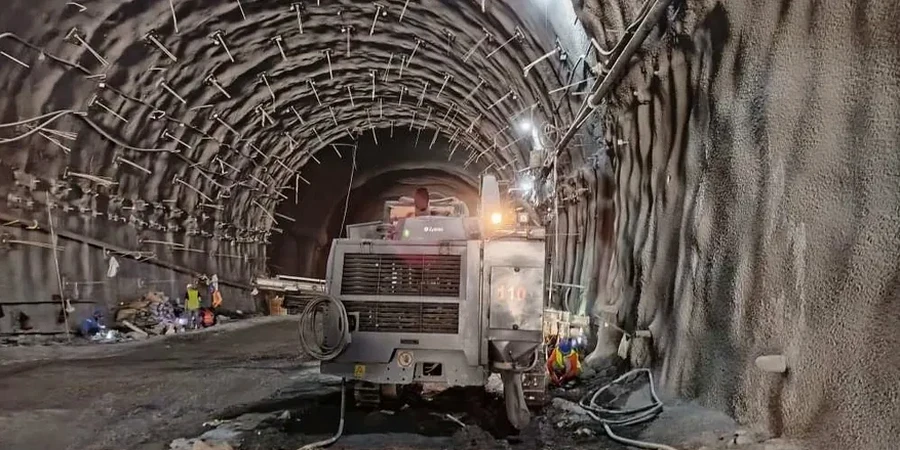
Technical reference image — Sheffield

Local geotechnical context

The Pennine climate shapes a lot of how we plan monitoring in Sheffield. Autumn and winter bring sustained rainfall that can push groundwater up by a metre or more in the shallow perched aquifers typical of the Coal Measures. That rapid recharge is behind most of the exceedances we have dealt with — a cut that looked dry in August suddenly has water streaming from a siltstone parting in November. If the monitoring frequency is too low, you miss the early signs of base heave or loss of passive resistance. We also watch for frost action in the near-surface clays during prolonged cold snaps, because freeze-thaw cycles can open micro-cracks in unsupported faces and accelerate the stand-up time decay that the observational method relies on. The combination of water, weathered mudstone and temperature swings makes Sheffield a place where monitoring is genuinely part of the temporary works design, not just a box-checking exercise.

Need a geotechnical assessment?

Reply within 24h.

Email: contact@geotechnical-engineering.biz

Typical values

ParameterTypical value
Inclinometer accuracy±0.25 mm/m (vertical profile)
Typical monitoring frequency (active phase)Daily, or twice-daily within 48 h of a trigger breach
Piezometer typeStandpipe Casagrande and vibrating-wire (VW) for automated logging
Trigger levels (Eurocode 7 approach)Green <70% design value, Amber 70-100%, Red >100% with action plan
Crack-width monitoring resolution0.1 mm using demountable strain gauges on adjacent buildings
Reporting formatDaily graphical summary + weekly formal report per BS 5930:2015
Survey datumOSGB36 grid with AOD Newlyn vertical datum, tied to permanent benchmarks

Associated technical services

01

Inclinometer and Shape Array Monitoring

Vertical and horizontal displacement profiles along soldier piles, secant walls or sheet-pile lines, with near-real-time automated alerts when deflection rates trend toward trigger values.

02

Piezometric and Groundwater Monitoring

Standpipe and VW piezometer networks designed around the Coal Measures' multi-aquifer behaviour, capturing seasonal recharge patterns that influence earth pressures on retaining structures.

03

Building Condition and Vibration Surveys

Pre-construction condition surveys, settlement markers and vibration monitoring for adjacent masonry and listed structures, with threshold levels aligned to BS 7385 and Sheffield City Council requirements.

04

Load and Strain Measurement in Temporary Works

Strain gauges on steel struts, load cells on ground anchors, and convergence arrays in shafts, providing direct feedback for the observational method under Eurocode 7.

Reference standards

BS 5930:2015+A1:2020 (Code of practice for ground investigations), BS EN 1997-1:2004+A1:2013 (Eurocode 7 — Geotechnical design, general rules), CIRIA C760 (Guidance on embedded retaining wall design), ICE Specification for Piling and Embedded Retaining Walls (SPERW, 3rd edition)

Questions and answers

How much does geotechnical excavation monitoring typically cost for a Sheffield project?

The fee for a monitoring campaign on a typical basement or retaining-wall excavation in Sheffield falls between £690 and £2,180, depending on the number of instruments, the duration of readings and the reporting frequency. A simple scheme with a couple of inclinometer casings and standpipe piezometers sits at the lower end; automated systems with real-time data platforms and weekly formal reports move toward the upper range.

When is monitoring mandatory under Eurocode 7 for a Sheffield excavation?

Eurocode 7 (BS EN 1997-1:2004) requires monitoring whenever the design relies on the observational method or when the consequences of failure are high — think deep cuts next to highways, railways or existing buildings. In Sheffield's Coal Measures, where ground variability is significant, monitoring is also strongly recommended where temporary support designs assume a specific stand-up time for unsupported cuts.

What are the most common trigger breaches you see on Sheffield sites?

The two most frequent alarms are groundwater rising faster than the design assumed — often after heavy Pennine rain — and lateral deflection rates that creep past the amber threshold when a siltstone layer softens in a wet cut face. Both are manageable if caught early, which is why we set automated alerts and keep the reporting turnaround under 24 hours during critical phases.

Can you monitor excavations near Sheffield's listed Victorian buildings without causing damage?

Yes, and we do it regularly. We start with a pre-condition survey and install crack-width gauges and vibration monitors on the structure itself, tied to a network of inclinometers and piezometers in the excavation. The key is setting conservative trigger values — typically 50 percent of the calculated threshold for cosmetic damage — so that work pauses well before any real distress occurs.
Location and service area

We serve projects across Sheffield and its metropolitan area.

View larger map