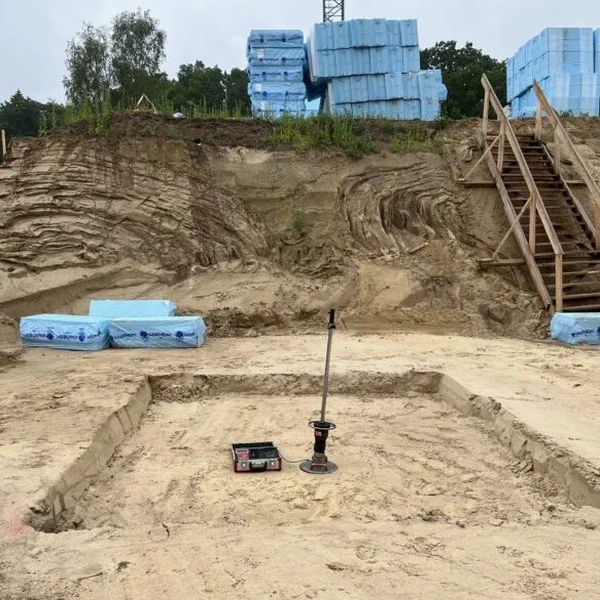
Sheffield’s industrial expansion from a medieval market town into a powerhouse of steel and engineering left a legacy of reclaimed land, backfilled quarries, and terraced slopes cut into the Pennine foothills. The River Don and its tributaries carved steep valleys where Victorian mills once stood, and today’s regeneration schemes—from Kelham Island residential blocks to advanced manufacturing parks along the Parkway—demand rigorous control of earthworks materials. Getting compaction right on Sheffield’s mixed glacial tills and made ground is not optional; it is the difference between a stable platform and costly settlement. Our UKAS-accredited laboratory runs both standard and modified Proctor tests to establish the moisture-density relationship that governs specification compliance. When site-won material is destined for structural fill beneath foundations, road sub-base, or embankments, the Proctor curve provides the target values against which field density tests are measured. We routinely pair this with grain-size analysis to confirm whether the material is well-graded enough to achieve the required dry density at the specified compactive effort.
A Proctor curve is not just a lab graph; it is the compaction specification that every roller pass on site is measured against.
Process and scope
A recent mixed-use development on a former steelworks site near Brightside presented a classic Sheffield challenge: the contractor proposed re-using on-site granular fill but needed to demonstrate it could meet a 95% relative compaction specification for the podium slab. We sampled the material from three stockpiles and ran a suite of modified Proctor tests using the 4.5 kg rammer and 450 mm drop specified in BS 1377-4:1990. The resulting compaction curves showed optimum moisture contents between 9.2% and 11.8%, with maximum dry densities ranging from 2.08 to 2.14 Mg/m³—tight enough to give the earthworks supervisor confidence in the method specification. The test procedure is methodical but unforgiving: material is compacted in five layers, each receiving 27 blows, and the entire moisture–density relationship is plotted from a minimum of five points. We oven-dry every specimen at 105°C to determine actual moisture content, because even a half-percent error shifts the curve and leads to either over-compaction in the field or failing density tests. For fine-grained soils common in Sheffield’s residual head deposits, the standard Proctor (2.5 kg rammer, 300 mm drop) is often more appropriate and better aligned with the compactive effort achievable with typical site plant. Understanding which variant applies—and why—saves rework and keeps earthworks programmes on track.
Local geotechnical context
The ground beneath Sheffield splits roughly into two worlds: the sandstone and shale of the Millstone Grit series that form the western heights around Broomhill and Crookes, and the alluvial silts and clays of the Don Valley floor around Attercliffe and Tinsley. A compaction specification that works perfectly on weathered sandstone-derived sandy silts in Crookes can fail badly on the softer, wetter silty clays of the Lower Don floodplain. The most common failure mode we see is contractors applying modified Proctor effort to moisture-sensitive fine-grained fill, driving the material into pore pressure buildup rather than densification—the compaction curve plateaus or even drops, and site density tests come back red. Ignoring this soil fabric difference leads to under-compacted fill, long-term settlement, and pavement cracking that shows up within two winters of freeze-thaw cycling. Another Sheffield-specific risk is the presence of buried slag and furnace waste: these materials can have particle crushing characteristics that invalidate a standard Proctor reference, requiring a tailored specification and often supplementary triaxial testing to confirm stiffness at target density.